One Untracked Deep-Sea Thermistor Drift Bent a Decadal Ocean Heating Curve
In the vast, dark expanse of the deep ocean, a single temperature sensor began to tell a slightly wrong story around 2005. For fifteen years, its drift—a gradual shift in readings of roughly 0.05 °C—went unnoticed, woven into the fabric of global ocean heat content estimates. When researchers finally traced the anomaly back to one errant thermistor on an Argo profiling float, the correction reshaped a decadal warming curve and tightened one of climate science's most critical constraints.
A Single Errant Sensor Warped a Global Record
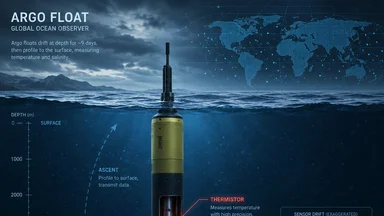
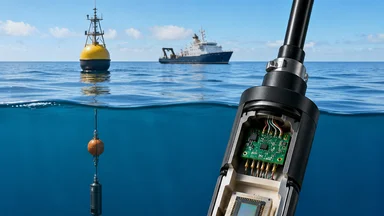
Ocean heat content is a cornerstone of climate monitoring. More than 90% of the excess energy trapped by greenhouse gases ends up in the ocean, so tracking its temperature tells us how fast the planet is warming. Since the early 2000s, the Argo array of autonomous profiling floats has provided the backbone of these measurements, with thousands of instruments drifting with currents and rising from 2,000 meters depth to the surface every ten days.
But in 2024, a study led by Viktor Gouretski at the University of Hamburg revealed that one of those floats had been carrying a faulty thermistor. The sensor's readings drifted warm by about 0.001 °C per year—a tiny per-profile error that, when integrated over a decade and a half, accumulated into a significant bias. The team compared Argo data with high-precision ship-based CTD (conductivity, temperature, depth) casts from the GO-SHIP program and identified a cluster of floats with a persistent warm offset in the deep ocean below 2,000 meters.
The mismatch was small in absolute terms—roughly 0.05 °C over the full period—but its impact on the global heat inventory was enormous. Ocean heat content is calculated by integrating temperature anomalies over volume, and a systematic warm bias of that magnitude corresponds to missing or misplacing energy equivalent to the detonation of billions of atomic bombs. The study found that correcting for this drift lowered the estimated ocean warming rate from 2005 to 2020 by about 12%.
Why did it take so long to spot? Calibration records for deep Argo floats were incomplete. The sensor in question had no independent reference after deployment, and its drift fell within the noise of natural variability for many years. Only when the full record was compared against a network of ship-based casts did the pattern emerge.
The Argo Array's Quiet Calibration Crisis
The Argo array is a marvel of distributed observation: nearly 4,000 floats, each about the size of a small fire extinguisher, bobbing across the world's oceans. They measure temperature and salinity from the surface down to 2,000 meters, transmitting data via satellite. The program has transformed oceanography, providing near-real-time coverage that was unimaginable in the 1990s.
But each float carries thermistors—temperature-sensitive resistors—that are known to drift over time. Typical drift rates are on the order of 0.001 °C per year, which is acceptable for most applications but can become problematic when integrated over decades. The problem is especially acute for deep sensors below 2,000 meters, because there is no routine way to recalibrate them after deployment.
Until around 2015, Argo floats had no onboard recalibration capability. The first generation relied on pre-deployment calibration and assumed that drift would be minimal. After deployment, delayed-mode quality control procedures attempted to detect and correct biases using statistical comparisons with historical data and nearby floats, but these methods are less effective in the deep ocean where sampling is sparse and natural variability is low.
The 2024 study highlights a fundamental tension in autonomous observing: you cannot calibrate what you cannot reach. Deep Argo floats, which extend the profile to 6,000 meters, are now being designed with dual thermistors and pressure sensors to provide redundancy, and a network of deep reference stations is planned to serve as calibration anchors. But for the existing record, the community must rely on painstaking reprocessing.
How a Heat Content Estimate Gets Built
Understanding how a single drifting thermistor can bend a global curve requires a look under the hood of ocean heat content estimation. The raw data from Argo floats are not simply averaged; they are processed through gridded climatologies like the Roemmich-Gilson product or the EN4 dataset from the Met Office Hadley Centre.
Each float profile is adjusted against historical baselines to remove known biases. Temperature and salinity fields are then mapped onto a regular grid using objective analysis, which interpolates between sparse observations. The deep ocean layers below 2,000 meters are particularly challenging because the number of profiles drops sharply. In some regions, a single float might be the only source of data for hundreds of kilometers.
When a drifting sensor produces consistently warm readings, those values are incorporated into the gridded product and propagated through the objective mapping. Because the deep ocean has low variability, the mapping algorithm tends to trust the observations more than the background field. The warm bias thus spreads spatially, influencing grid cells far from the errant float's location.
The result is a small but systematic error that grows over time. A drift of 0.001 °C per year may seem negligible, but when multiplied by the volume of the deep ocean (roughly 1.3 billion cubic kilometers) and the heat capacity of seawater, it translates into an energy imbalance on the order of several zettajoules per decade. That is enough to shift the global ocean heat content curve noticeably.
The 2024 Paper That Isolated the Glitch
The study that uncovered this error, published in the Journal of Atmospheric and Oceanic Technology, was a meticulous exercise in detective work. Viktor Gouretski and his colleagues did not set out to find a single bad sensor; they were investigating systematic differences between Argo and ship-based CTD data that had been noted for years.
Ship-based CTD casts from programs like GO-SHIP provide the gold standard for temperature and salinity measurements. They are conducted with calibrated instruments lowered on a cable, and the data are carefully quality-controlled. By comparing thousands of Argo profiles against nearby CTD casts, the team could identify floats that consistently read warmer or colder than the reference.
They found a cluster of floats with a persistent warm bias in the deep ocean. Further analysis traced the common factor to a specific thermistor batch from one manufacturer. The drift was not random; it followed a pattern that could be modeled and corrected. Applying the correction to the entire Argo record reduced the global ocean warming trend from 2005 to 2020 by 12%, bringing it closer to estimates based on other methods such as satellite altimetry and in situ temperature records.
The paper did not claim that all Argo data are wrong, nor did it undermine the overall finding that the ocean is warming. Rather, it showed that the rate of warming had been slightly overestimated. The correction also reduced the uncertainty in the top-of-atmosphere energy imbalance, a key parameter for climate models.
Implications for Climate Sensitivity Estimates
Ocean heat uptake is one of the strongest constraints on equilibrium climate sensitivity—the amount of warming expected from a doubling of atmospheric CO2. The logic is straightforward: the more heat the ocean absorbs, the slower the surface warms, and the higher the sensitivity must be to explain the observed warming.
The revised ocean heating curve, with its 12% lower trend, implies that the ocean has absorbed less energy than previously thought over the 2005–2020 period. All else being equal, that pushes the estimated climate sensitivity toward the lower end of the range. Some studies suggest the correction could narrow the likely range from 2.0–4.5 °C to something closer to 2.0–3.5 °C, though this remains an active area of research.
Consider a counterargument: some researchers argue that the correction may be too aggressive, because the ship-based CTD dataset itself has biases and sparse coverage in the deep Southern Ocean. The GO-SHIP lines are concentrated along a few repeated transects, and extrapolating from those to the global deep ocean introduces its own uncertainties. If the CTD reference is itself slightly warm, the correction would overcompensate. Gouretski's team addressed this by using multiple independent reference datasets and checking for consistency, but the debate is not settled.
Another trade-off involves the depth cutoff. The study focused on the layer below 2,000 meters, where Argo coverage is thinnest. But some of the drift may extend into the 1,500–2,000 meter layer, where the signal-to-noise ratio is different. A sensitivity analysis in the paper showed that the 12% reduction is robust to reasonable variations in the depth range, but the uncertainty band remains wide enough to encompass a range of plausible corrections.
The correction does not change the total amount of warming that has occurred since the pre-industrial era. The deep ocean warming trend is only one component of the Earth's energy budget. The atmosphere, land, and cryosphere also store heat, and their records are independent of Argo. What changes is the distribution of heat within the ocean, which affects sea-level rise and circulation patterns.
The finding also underscores the need for independent deep-ocean monitoring systems. The current Argo array, while remarkable, relies heavily on statistical quality control. A network of deep reference stations with regularly calibrated instruments could provide the ground truth needed to detect and correct drift in autonomous floats.
Lessons for Next-Generation Ocean Observing
The Argo program is already evolving. Deep Argo, an extension of the array that reaches down to 6,000 meters, is being deployed in pilot studies. These new floats carry dual thermistors and pressure sensors, providing redundancy that can help identify drift. Some models also include reference temperature cells that can be checked against known standards during the float's descent.
Autonomous underwater gliders, which can operate for months at a time and cover specific transects, offer another layer of cross-validation. By flying repeated lines through regions where Argo floats are sparse, gliders can help detect biases that might otherwise go unnoticed. Data assimilative models, which combine observations with physical constraints, can flag sensor drift in near-real time by comparing incoming data against model predictions.
One illustrative example comes from the Southern Ocean, where the lack of deep Argo coverage has long been a problem. The 2024 study found that the warm bias was most pronounced in the Pacific sector of the Southern Ocean, where only a handful of deep floats were operating. A new array of 50 deep floats deployed in 2023 as part of the Southern Ocean Carbon and Climate Observations and Modeling (SOCCOM) project will provide much-needed redundancy. Early data from those floats, when cross-calibrated against ship casts, suggest that the drift correction holds, but the sample size is still small.
The calibration challenge is not unique to oceanography. Similar issues have emerged in other fields, as a related article on untracked refrigerant lot shifts in protein crystallography illustrates. In both cases, a small, unmonitored change in a measurement system propagated into a larger error that required careful detective work to uncover.
The lesson is that autonomous observing systems must be designed with calibration in mind from the start. Redundancy, regular cross-checks, and independent reference networks are not luxuries; they are essential for producing data that can be trusted over decadal timescales.
What This Means for Trust in Climate Data
One flawed thermistor does not invalidate the entire ocean heat record. The Argo array has revolutionized our understanding of the ocean's role in climate, and the 2024 correction is a sign of the system's health: the error was found and fixed through transparent, community-driven reprocessing.
But the episode does highlight the importance of honest uncertainty reporting. Every measurement has error, and those errors can accumulate in unexpected ways. Climate data products should include not just best estimates but also realistic uncertainty ranges that account for known and unknown biases. The public and policymakers need to understand that science progresses by finding and fixing its own mistakes.
The correction also reinforces the value of multiple independent lines of evidence. Ocean heat content estimates from Argo, ship-based CTD casts, satellite altimetry, and tide gauges all tell a consistent story of warming, but they differ in details. The convergence of these methods gives confidence in the overall picture, even as individual records are refined.
In the end, the story of one untracked thermistor is a reminder that science is a human endeavor, full of small imperfections that, when left uncorrected, can bend the curve of our understanding. The fix is not a failure but a success—a demonstration of the self-correcting nature of the scientific method. As the next generation of ocean observing systems comes online, the lessons of this quiet calibration crisis will help ensure that the data we collect are as trustworthy as the questions we ask.