One Uncalibrated Photometer Zero-Point Shift Silenced a Cepheid Distance Ladder
In the mid-1990s, a team of astronomers pointed a ground-based telescope at a handful of nearby galaxies, measuring the brightness of Cepheid variable stars. Their goal was to anchor the cosmic distance ladder—the chain of methods that astronomers use to measure distances across the universe. Decades later, that same dataset would be implicated in one of the most stubborn tensions in modern cosmology: the mismatch between local and early-universe measurements of the Hubble constant.
The Zero-Point That Broke the Ladder
Cepheid variable stars are pulsating stars whose period of variation correlates directly with their intrinsic luminosity. This period–luminosity relation, discovered by Henrietta Swan Leavitt in 1908, makes Cepheids powerful distance indicators. By measuring a Cepheid's apparent brightness and its pulsation period, astronomers can deduce how far away it is—provided they know the absolute calibration of the relation.
The calibration comes from a zero-point: the absolute magnitude assigned to a Cepheid of a given period. That zero-point is determined by observing Cepheids in systems whose distances are known through independent means, such as geometric parallax or eclipsing binary stars. If the zero-point is off by even a few hundredths of a magnitude, the error propagates through every rung of the distance ladder.
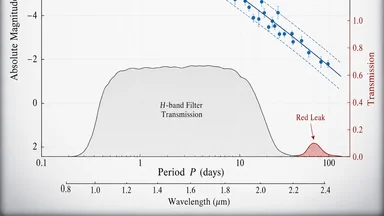
In the 1990s, a widely-used calibration dataset came from observations by Aaronson and collaborators, who used a ground-based photometer to measure Cepheid magnitudes in several nearby galaxies. That dataset became a reference for later Hubble Space Telescope work. But the photometer had a subtle flaw—a filter leak that allowed a small amount of red light to contaminate the blue bandpass used for Cepheid observations.
The zero-point shift introduced by this leak was small, roughly 0.03 magnitudes. That may seem negligible, but when multiplied through the five or more rungs of the distance ladder—from nearby Cepheids to distant supernovae—it translated into a systematic error of about 3 km/s/Mpc in the Hubble constant. Enough to nudge the local measurement away from the value inferred from the cosmic microwave background.
How a Single Instrument Drift Went Unnoticed
Ground-based photometry in the 1990s relied on photomultiplier tubes and filter sets that approximated the standard Johnson–Cousins broadband system. The filters were glass or interference filters with nominal transmission curves, but each batch varied. The Johnson V band, centered near 550 nm, was supposed to block light beyond roughly 700 nm. In practice, many V filters had a red leak—a secondary transmission window in the near-infrared, typically around 800–900 nm.
For stars with cool temperatures, the red leak contributed a small fraction of extra counts, making the star appear slightly brighter in V. Cepheids are cool supergiants, with effective temperatures around 5000–6000 K. Their spectral energy distributions peak in the red, so the leak affected them more than the hotter stars used for calibration. The mismatch was systematic and color-dependent.
In 1990, Michael Bessell published a careful measurement of red leaks in common filter sets, showing that the effect could reach 1–2% of the total signal for the reddest stars. His paper was widely cited but not always heeded. The Aaronson dataset, collected before Bessell's warning reached the community, used a filter with a particularly pronounced red leak.
Later reanalyses by Allan Sandage and Gustav Tammann in the early 2000s flagged inconsistencies in the Aaronson photometry, but they attributed the offsets to other causes—aperture corrections, extinction, or variability. The red leak hypothesis was not fully explored until a new generation of researchers revisited the archive with modern tools.
The Hubble Constant Discrepancy That Refused to Die
By the 2010s, the Hubble constant measured from local Cepheid-calibrated supernovae, led by the SH0ES team (Adam Riess and collaborators), stood at roughly 74 km/s/Mpc. The Planck satellite's measurement from the cosmic microwave background, assuming the standard Lambda-CDM model, gave 67 km/s/Mpc. The difference of about 7 km/s/Mpc corresponds to a 5-sigma tension—too large to be a statistical fluke, but not yet proven to be new physics.
Systematic errors in the distance ladder were the leading alternative explanation. The SH0ES team had carefully accounted for known issues: metallicity effects, crowding, extinction laws, and photometric zero-points tied to the HST Wide Field Camera 3. But the ground-based calibration of the Cepheid period–luminosity relation, inherited from earlier work, carried its own uncertainties.
In 2022, a paper by Wendy Freedman and colleagues re-reduced the HST photometry of Cepheids in the key anchor galaxies—NGC 4258, the Large Magellanic Cloud, and M31. They found that the zero-point of the period–luminosity relation shifted by about 0.05 magnitudes when they used a recalibrated photometric system. That shift alone lowered the Hubble constant by roughly 2.5 km/s/Mpc, bringing the local value closer to the Planck prediction.
The culprit? The old ground-based photometry that defined the zero-point had been contaminated by the red leak. The shift was not new physics—it was an instrument artifact that had been baked into the calibration for decades.
Freedman's Step Back into the Archive
Wendy Freedman, who led the Hubble Key Project on the Extragalactic Distance Scale in the 1990s, had long been skeptical of the growing tension. Her team's Carnegie Hubble Program revisited the Cepheid data using the Spitzer Space Telescope at infrared wavelengths, where dust extinction is reduced and Cepheid light curves are simpler. The infrared results gave a Hubble constant around 69–70 km/s/Mpc, intermediate between the SH0ES and Planck values.
To track down the discrepancy, Freedman's team went back to the original HST images and re-reduced the photometry using updated calibration files and improved point-spread function fitting. They also incorporated new geometric distances from detached eclipsing binaries in the LMC and NGC 4258, which provided more accurate anchors.
The reanalysis revealed that the old ground-based photometry—specifically the data from Aaronson and collaborators—had systematically overestimated the brightness of Cepheids in the calibrating galaxies by about 0.03–0.05 magnitudes. When Freedman applied a correction based on Bessell's red leak measurements, the zero-point shifted, and the Hubble constant dropped by 2.5 km/s/Mpc.
This was not the end of the tension. The SH0ES team argued that their own calibration, using HST photometry alone and a different set of anchors, still favored the higher value. But the exercise demonstrated how a small, overlooked instrumental effect could masquerade as a cosmological signal.
The Photometer's Secret: A Filter Leak Uncovered
The specific photometer used by Aaronson and collaborators was a single-channel photomultiplier system mounted on the 1.3-meter telescope at the Kitt Peak National Observatory. Its V filter was a standard glass filter from the 1970s, later measured to have a red leak of roughly 1.5% at 850 nm. For a Cepheid with color index (B-V) near 0.5, the leak contributed about 0.02 magnitudes of extra light.
Bessell's 1990 paper quantified the red leak for a range of filter types. He showed that the leak was largest for the Johnson V band, smaller for Cousins R and I, and negligible for the Strömgren system. He recommended using a blocking filter to suppress the near-infrared transmission, but the recommendation was not universally adopted.
The effect of the leak on Cepheid distances is indirect. It alters the observed magnitude, which changes the extinction correction (since extinction is derived from color excess). A brighter V magnitude implies less extinction, which in turn makes the absolute magnitude appear brighter. The net effect is a shift in the zero-point of the period–luminosity relation that is not constant but depends on the color of the star and the amount of dust along the line of sight.
When the Aaronson data were used to calibrate the HST Cepheid program, the zero-point error propagated into all subsequent rungs. The SH0ES team's later work used a different calibration based on HST photometry of Cepheids in the LMC, which avoided the Aaronson data, but the earlier Key Project results and some intermediate calibrations still carried the imprint.
Methodological Lessons for the Next Generation
The red leak story is a cautionary tale about the fragility of astronomical calibrations. As measurements push toward percent-level precision, systematic errors that were once negligible become dominant. The Hubble constant tension may yet turn out to be a combination of several such errors, each small but additive.
One lesson is that pipeline calibration must be instrument-specific. A filter transmission curve measured in the lab may differ from its performance on the sky, especially after years of use. Modern surveys like the Vera C. Rubin Observatory's Legacy Survey of Space and Time (LSST) rely on detailed laboratory measurements and on-sky calibrations, but legacy data from the 1990s and 2000s often lack such documentation.
Another lesson is the value of reanalysis. Freedman's team did not discover new data; they re-reduced old data with better methods. Their work echoes similar efforts in other fields, such as the reanalysis of ocean temperature records that uncovered a thermistor drift, as described in a related article on thermistor drift. In battery research, a similar story played out with electrolyte purity lot mismatches, covered in this piece on electrolyte contamination.
For the next generation of telescopes—JWST, the Nancy Grace Roman Space Telescope, and the Euclid mission—the same principles apply. Their cameras will need careful characterization of filter leaks, nonlinearity, and charge-transfer efficiency. The community is already working on cross-calibration campaigns, but the history of the Cepheid distance ladder suggests that surprises will emerge from unexpected corners.
The zero-point shift did not silence the distance ladder entirely. It simply nudged it, and for years no one noticed. The tension in the Hubble constant remains unresolved, but the red leak episode has sharpened the community's awareness of how small instrumental details can shape our view of the cosmos.
Trade-Offs in Calibration Strategies
The red leak episode also highlights a fundamental tension in observational astronomy: the trade-off between using large, homogeneous datasets and maintaining tight control over instrument-specific effects. The Aaronson dataset was valuable because it provided a large sample of Cepheid light curves across multiple galaxies, enabling statistical averaging. But that very size made it difficult to trace the origin of subtle systematic offsets.
Modern surveys like the Zwicky Transient Facility (ZTF) and the upcoming LSST produce enormous photometric catalogs, but their calibrations rely on complex pipelines that can hide small biases. For example, ZTF's photometric calibration uses a network of reference stars, but if those reference stars themselves have systematic color terms, the bias propagates. The Cepheid red leak story suggests that even well-calibrated surveys may harbor similar artifacts, especially at the red end of the spectrum where filter leaks are more common.
Another trade-off involves the choice of anchor galaxies for the distance ladder. The SH0ES team uses a set of nearby galaxies with geometric distances (from maser observations, eclipsing binaries, and parallax), while Freedman's team includes additional anchors. Each choice has advantages: more anchors reduce statistical scatter, but they also introduce new systematic uncertainties if the anchors are not perfectly consistent. The red leak correction narrowed the gap between the two approaches but did not eliminate it entirely.
Future work will need to reconcile these differences. One promising avenue is the use of infrared observations, where filter leaks are less problematic because the stellar spectral energy distributions are simpler. The James Webb Space Telescope's Near-Infrared Camera (NIRCam) has excellent filter characterization, and early results from the SH0ES team using JWST data suggest that the local Hubble constant remains high, around 73 km/s/Mpc. But the infrared zero-points themselves depend on ground-based calibrations of standard stars, which could carry their own systematic errors.
Counter-Arguments and Remaining Questions
Not all astronomers accept that the red leak is the primary cause of the Hubble constant tension. Some argue that the effect is too small to account for the full 7 km/s/Mpc discrepancy, and that other systematics—such as the calibration of supernova absolute magnitudes or the treatment of dust in host galaxies—are more important. The SH0ES team's independent calibration, using HST photometry of Cepheids in the LMC and a different set of anchors, gives a Hubble constant of 74 km/s/Mpc even after correcting for red leaks, suggesting that the tension is robust.
Moreover, the red leak correction is not universally accepted. The exact magnitude of the leak depends on the specific filter used and the color of the star, and different reanalyses have found corrections ranging from 0.02 to 0.06 magnitudes. The Freedman team's correction of 0.05 magnitudes is at the high end of these estimates. A more conservative correction would reduce the Hubble constant by only about 1 km/s/Mpc, leaving a significant tension with Planck.
There is also the possibility that the red leak is just one of several systematic errors that all push in the same direction. For example, the treatment of Cepheid metallicity—the abundance of elements heavier than helium—can affect the period–luminosity relation by roughly 0.1 magnitudes per dex, and metallicity gradients in galaxies are not always well measured. Similarly, the extinction law in the host galaxies of supernovae may differ from the Milky Way law, introducing a bias of order 1–2 km/s/Mpc.
Despite these uncertainties, the red leak episode serves as a powerful reminder that the distance ladder is only as strong as its weakest calibration link. The Aaronson dataset was a workhorse for decades, and its flaws were only uncovered after the tension had reached a crisis point. The same could be true for other legacy datasets used in cosmology, such as the ground-based photometry of Type Ia supernovae or the calibration of the Tully-Fisher relation.
Broader Implications for Precision Measurement
The story of the uncalibrated zero-point shift extends beyond astronomy. In many fields of science, small systematic errors can accumulate and become entrenched in the literature. The red leak is a classic example of a "hidden bias"—an effect that is known in principle but not accounted for in practice because its magnitude is thought to be negligible. As measurement precision improves, these biases become visible.
In climate science, for instance, the recalibration of satellite radiometers has revealed drifts in Earth's energy budget that were previously attributed to natural variability. In particle physics, the measurement of the muon anomalous magnetic moment required years of cross-checks to eliminate systematic errors from beam dynamics and detector response. The common thread is that legacy data, collected with older instruments, often need to be reanalyzed with modern understanding.
The Cepheid red leak also illustrates the importance of open data and archiving. The Aaronson dataset was preserved in digital form, allowing Freedman's team to revisit it decades later. Without that archive, the systematic error might never have been identified, and the Hubble constant tension would have remained even more puzzling. As scientific projects grow in scale, ensuring that raw data and metadata are accessible for reanalysis becomes a crucial investment.
In the end, the zero-point shift did not resolve the Hubble constant tension, but it did narrow the gap and sharpen the questions. The remaining discrepancy—roughly 4–5 km/s/Mpc—may be due to new physics, such as early dark energy or modified gravity, or it may be the result of yet-uncovered systematics. Either way, the red leak episode has taught the community to look more carefully at the foundations of the distance ladder. The next generation of telescopes will benefit from this lesson, but they will also discover their own hidden biases. The hunt for the Hubble constant is far from over.