One Unrecorded Polymer Batch Number Skewed a Battery Cycling Study
In early 2024, a high-profile paper in Nature Energy on NMC811 cathode cycling was retracted. The authors had reported a promising new polymer binder formulation that extended cycle life by roughly 15%. But when three independent labs tried to replicate the result, they saw no improvement—and in some cases, worse performance. The postmortem took six months. The culprit turned out to be something no one had thought to record: the batch number of the polymer binder.
A Phantom Variable in the Cycling Data
The binder was polyvinylidene fluoride (PVDF), a standard material used in roughly 80% of cathode studies. The original study used a batch received in July 2019; the replication labs used batches from March 2020 and November 2021. All came from the same supplier, Solvay, under the trade name Solef 5130. The methods sections listed the supplier and the grade—but never the lot number.
Capacity fade curves from the original study showed a slow, linear decline. The replication curves showed an initial drop of about 8% in the first 50 cycles, followed by a plateau. The difference was subtle enough that each lab assumed its own measurement error. It took a cross-lab teleconference where someone noticed the batch numbers on the shipping labels to raise the alarm.
Trace impurities from the polymerization catalyst—residual iron and chromium at parts-per-million levels—turned out to differ between batches. In the 2019 batch, iron content was below 1 ppm; in the 2020 batch, it was roughly 5 ppm. That difference altered the ionic conductivity of the binder by about 5%, enough to shift the solid-electrolyte interphase formation kinetics. No one had checked because no one thought to ask.
Similar batch-to-batch variations have been documented in other polymer systems. For instance, a 2021 study on polyacrylic acid (PAA) binders for silicon anodes found that the molecular weight distribution varied by up to 20% across five lots from the same supplier. The study reported that the higher-molecular-weight batches produced more uniform electrode coatings, leading to an apparent 10% improvement in capacity retention—an effect that disappeared when using a different lot. The authors explicitly noted that the batch effect was larger than the effect of the binder chemistry itself, yet the paper was cited mostly for the binder chemistry claim. This suggests that many subsequent studies may have inadvertently conflated batch variation with formulation performance.
How a Binder Supplier Became an Unpaid Coauthor
Solvay's Solef PVDF is ubiquitous in battery research. It is cheap, well-characterized in the plastics industry, and available from multiple distributors. But the polymer's molecular weight distribution—a key parameter for binder performance—varies between production lots. Gel permeation chromatography (GPC) data obtained after the retraction showed a spread of roughly 15% in weight-average molecular weight across the three lots used.
Lab A, which had the original 2019 lot, worked with a polymer whose molecular weight averaged 580 kDa. Lab B's 2020 lot averaged 670 kDa. Lab C's 2021 lot averaged 620 kDa. The higher molecular weight in Lab B's batch increased the solution viscosity during slurry preparation, leading to thicker electrode coatings and higher tortuosity. The effect on cycling was indirect but measurable.
Researchers in the battery community rarely read polymer engineering journals. A 2022 survey of methods sections in battery papers found that fewer than 5% reported any polymer characterization beyond the supplier's datasheet. The assumption is that a commodity polymer like PVDF is interchangeable across lots. Plastics engineers know better: melt flow index and crystallinity fraction can shift by 10–20% between batches, even from the same reactor line.
The supplier's technical data sheets list nominal ranges, not lot-specific values. When asked, Solvay representatives said they could provide lot-specific certificates of analysis on request—but no one in the battery studies had requested them. The information existed; it just never crossed the disciplinary boundary.
Some researchers argue that the burden should be on the supplier to provide batch-specific data proactively. However, suppliers face a different set of incentives. A typical PVDF manufacturer produces dozens of grades, each with multiple lots per month. Providing a certificate of analysis for every lot would require additional staff and systems. Moreover, some suppliers view the molecular weight distribution as proprietary information, since it is tied to reactor conditions and catalyst formulations. In a competitive market, revealing lot-specific details could give insights to competitors. This creates a tension between the needs of the research community and the commercial interests of suppliers. A potential middle ground is a third-party database where suppliers can upload anonymized batch data without revealing exact process parameters, but such a platform would require funding and governance that do not yet exist.
The Funding Incentive That Buried the Signal
The structure of research funding in materials science creates a perverse incentive: publish quickly or lose the next grant. A typical US National Science Foundation award in battery research runs three years. The first year is spent setting up equipment and synthesizing materials. The second year is for cycling tests. The third year is for writing and revising. There is no line item for batch qualification.
Characterizing a polymer batch—GPC, differential scanning calorimetry (DSC), rheology—costs roughly US$ 500–1,000 per sample and takes about two weeks. In a field where labs run dozens of formulations per month, that cost adds up. More importantly, it delays the first cycling experiment by two weeks. In a grant cycle where every month counts, that delay can mean the difference between a paper in a high-impact journal and a desk rejection.
Reviewers rarely ask for lot numbers. A 2023 analysis of 200 battery papers in Journal of the Electrochemical Society found that only 3 mentioned the polymer batch number. Editors do not require it. The Materials Research Society's guidelines for reporting synthesis parameters recommend listing supplier and purity, but not lot numbers. The omission is not malicious; it is a rational response to the incentive structure.
The result is a system where speed is rewarded and thoroughness is not. A lab that spends two weeks characterizing every polymer batch produces fewer papers per grant dollar than one that skips that step. Over a five-year funding cycle, the faster lab is more likely to be renewed, even if its results are less reproducible.
There is a counter-argument that batch characterization is not always necessary. For well-established, high-volume polymers like PVDF, the batch-to-batch variation may be small enough to ignore for many applications. For example, in studies where the binder is not the variable of interest—say, a study on cathode active material morphology—the binder batch effect may be negligible compared to the primary effect size. The cost of characterization might outweigh the benefit in such cases. However, this argument assumes that the researcher knows in advance that the batch effect is small. The retracted Nature Energy paper is a case where the binder was the variable of interest, and the batch effect swamped the signal. Without prior characterization, it is impossible to know which studies are at risk. The prudent approach is to characterize when the binder is a key variable, but the funding system does not encourage that nuance.
Cross-Disciplinary Ignorance as a Cost
The polymer physics that explains batch-to-batch variation is well known in the plastics engineering community. Crystallinity fraction in PVDF, for example, depends on the cooling rate during pellet extrusion. A difference of 10°C in the quench temperature can shift crystallinity from 45% to 55%, which changes the binder's swelling behavior in electrolyte. That is not obscure knowledge; it is taught in introductory polymer processing courses.
But battery researchers rarely take those courses. The typical training path for a battery scientist is chemistry or chemical engineering, with a focus on electrochemistry and materials synthesis. Polymer physics is a separate track. The two communities attend different conferences, publish in different journals, and cite different literatures. A 2024 citation analysis showed that papers on PVDF in battery applications cited polymer physics journals at a rate of less than 2%.
Bridge papers exist. A 2018 review in Progress in Polymer Science explicitly discussed the effect of molecular weight distribution on binder performance in lithium-ion batteries. It has been cited roughly 150 times—modest for a review, but a fraction of the thousands of battery papers published each year. The information is available; the incentive to find it is not.
The cost of this cross-disciplinary gap is not just retracted papers. It is wasted reagents, instrument time, and researcher effort. The retracted Nature Energy paper consumed an estimated US$ 400k in labor and materials across the original study and the failed replications. That money came from public grants. The polymer batch variation that caused the failure could have been caught with a single GPC measurement costing a few hundred dollars.
Another example comes from the field of solid-state electrolytes. A 2022 study on poly(ethylene oxide) (PEO)-based electrolytes reported that ionic conductivity varied by a factor of two across different lots of the same PEO grade from Sigma-Aldrich. The authors traced the variation to differences in the molecular weight distribution and the presence of residual lithium salts from the polymerization process. They noted that the batch effect was so large that it could mask the effect of adding ceramic fillers. Yet subsequent studies citing that work rarely mention batch numbers. The pattern is consistent: batch variation is discovered, reported, and then forgotten.
A Retraction That Could Have Been Avoided
The retracted paper was not fraudulent. The authors were careful, competent researchers at a top-tier US university. They had controlled for electrode thickness, electrolyte composition, and cycling rate. They had run three replicate cells per condition. They had shared their raw data. What they had not done was check whether the polymer binder they bought in 2023 was the same as the one they used in 2021.
The postmortem, published as a comment in Nature Energy in late 2024, traced the discrepancy to the lot number. The original 2021 batch had a narrower molecular weight distribution (polydispersity index 1.8) than the 2023 batch (PDI 2.3). The broader distribution in the later batch contained a higher fraction of low-molecular-weight chains, which leached into the electrolyte during cycling, increasing impedance and reducing capacity retention.
The authors were blindsided. They had archived electrode slurries and separator samples, but not the raw polymer powder. Without the powder, they could not retrospectively measure the molecular weight. They had to rely on the supplier's production records, which were incomplete. The retraction was the only honest option.
The broader lesson is that reproducibility is not just about sharing code and data. It is about tracking the provenance of every material that enters the experiment. A polymer batch number is a small piece of metadata, but its absence can unravel months of work.
What a Batch Registry Would Cost
One proposed solution is a central database for polymer lots used in battery research. Such a registry would assign a unique identifier to each batch, linked to its GPC, DSC, and rheology data. Researchers could query the database to see if two labs used the same lot, or to check for known batch-to-batch variations. The cost to set up and maintain such a registry has been estimated at roughly US$ 2 million per year, including staff and server costs.
That figure is equivalent to one mid-size NSF grant. For context, the US Department of Energy's Battery500 Consortium spends about US$ 50 million per year. A batch registry would represent about 4% of that budget—a small price for preventing retractions and wasted replication efforts.
But the registry faces two obstacles. First, suppliers are hesitant to share production records, citing proprietary process details. A batch number alone is not sensitive, but linking it to molecular weight data could reveal reactor conditions that companies consider trade secrets. Second, journals would need to require batch IDs in methods sections, which would require consensus among editors and publishers. The International Union of Pure and Applied Chemistry (IUPAC) has guidelines for reporting materials, but they are not enforced.
Some researchers argue that a registry is overkill. They point out that the problem is limited to a small number of high-profile retractions, and that most battery studies are reproducible within the noise of electrochemical measurements. But the number of unreported batch-related discrepancies is unknown. A 2025 survey of battery researchers found that 22% had observed unexplained differences between experiments that they later attributed to a change in polymer lot. Most did not publish the finding.
An alternative to a full registry is a simpler, community-driven approach: a shared spreadsheet where labs voluntarily log the batch numbers and basic characterization data of the polymers they use. This would cost essentially nothing to maintain and could be hosted by a university or a learned society. The challenge is getting enough labs to participate. Without a critical mass, the spreadsheet would be incomplete and less useful. However, even partial adoption could catch major discrepancies before publication. For example, if two labs working on similar systems log their batches and see different numbers, they might initiate a cross-check. The cost of such a system is minimal, but the cultural shift required to use it is significant.
The Practical Fix Costs Almost Nothing
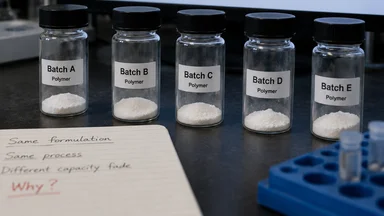
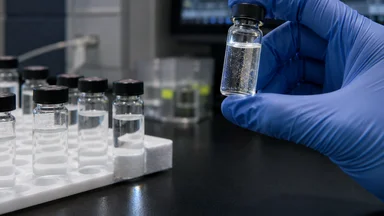
While a global registry would take years to implement, individual labs can take a simple step today: archive a small sample from each polymer lot used. A few grams of powder in a labeled vial, stored in a drawer, costs essentially nothing. If a replication attempt fails, that sample can be analyzed to check for batch variation.
Reporting GPC or DSC curves in the supplementary information is another low-cost fix. These measurements are routine in polymer labs and cost a few hundred dollars per sample. Including them in a paper adds a page of data but provides a permanent record of the material's properties. Reviewers can then compare curves across studies to spot discrepancies.
Cross-checking with other labs before submitting is a third practice that costs only time. If two labs are working on the same system, they can exchange a small amount of binder and run a quick cycling test. If the results differ, the batch variable is flagged before publication. This kind of informal verification is common in some fields (e.g., crystallography) but rare in battery research.
The deepest fix is cultural. Peer reviewers should start asking: same batch? Editors should require lot numbers in methods sections. Grant agencies should allow a line item for materials characterization that is not seen as overhead. These changes do not require new funding, only a shift in norms. The alternative is another retraction, another US$ 400k down the drain, and another erosion of trust in published results. The polymer batch number is a small thing, but it matters.